Asia
China · Qué significan los colores y símbolos
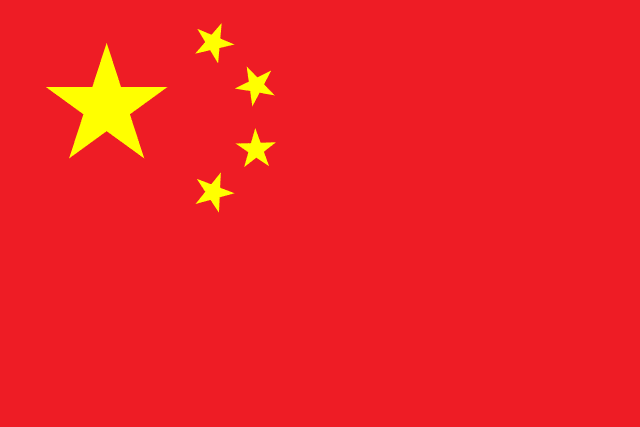
China — flagcdn.com/w640
Datos clave
- Adopción
- 1 October 1949 (adopted by the First Plenary Session of the CPPCC on 27 September 1949)
- Proporciones
- 2:3
- Diseño
- Zeng Liansong
- Capital
- · 07:48 (hora local ahora)
Qué significan los colores y símbolos
Red fieldDocumentado / oficial
Symbolises revolution — the official wording of the 1949 flag resolution.
Large starDocumentado / oficial
Represents the Communist Party of China.
Four small starsDocumentado / oficial
Represent the Chinese people — originally worded in 1949 as the four classes (workers, peasants, petty bourgeoisie and national bourgeoisie); each small star has one point aimed at the centre of the large star, symbolising unity.
Breve historia
In 1949 a public call drew nearly 3,000 designs; the entry by Zeng Liansong of Shanghai was selected and revised, then adopted by the CPPCC and first raised in Tiananmen Square on 1 October 1949. Its construction is fixed by the 1949 resolution and later national standards.
Explora este país
Ciudades de este país
Imágenes de banderas: FlagCDN (flagcdn.com). Los significados, las fechas de adopción y las proporciones se compilan de registros vexilológicos públicos y fuentes oficiales; cada entrada de simbolismo se etiqueta como documentada/oficial o como lectura popular (no oficial). Lo que no pudo verificarse se omite, no se adivina.
De este sitio
🎉 Cuentas atrás en directo a los festivales del mundo
Fiesta de la Primavera, Navidad, Pascua, Diwali, el próximo cambio de horario y más, cada uno con su página y su tarjeta para compartir.
De este sitio
🧰 Herramientas de tiempo gratuitas en una sola caja
Hora exacta con milisegundos, conversor Unix, cronómetro, temporizador, calculadora de duración y de semana/edad.
Fuentes de datos: Open-Meteo (el tiempo) · ExchangeRate API (divisas, actualización por horas/días) · Nager.Date (festivos) · Wikipedia (tal día como hoy) · GeoNames (datos básicos de ciudades, CC BY 4.0)