Europa
Alemania · Qué significan los colores y símbolos
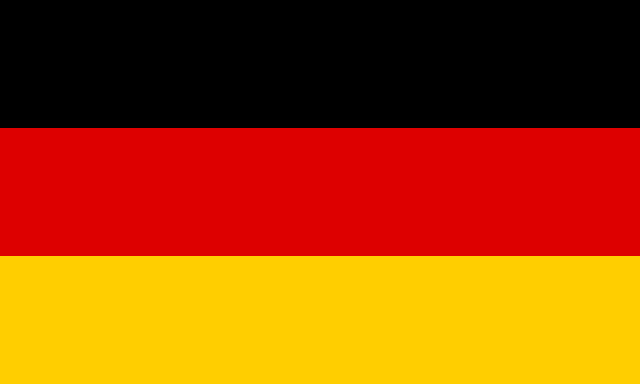
Alemania — flagcdn.com/w640
Datos clave
- Adopción
- 23 May 1949 (Article 22 of the Basic Law)
- Proporciones
- 3:5
- Capital
- · 00:48 (hora local ahora)
Qué significan los colores y símbolos
Black, red and goldDocumentado / oficial
The colours trace to the Wars of Liberation — the black uniforms with red facings and gold buttons of the 1813 Lützow Free Corps, and the 1815 Jena student fraternity's colours — the standard documented origin.
Black = dark past, red = blood of struggle, gold = light of freedomLectura popular, no oficial
An interpretation from the 19th-century student movement, extremely widely repeated, but not written into the Basic Law or flag legislation.
Breve historia
Black-red-gold first flew for all Germany in 1848 (Frankfurt Parliament). After the black-white-red of the North German Confederation and Empire, the Weimar Republic restored it; interrupted under Nazism, it was re-established by the Federal Republic's Basic Law in 1949 and became the flag of reunified Germany in 1990.
Explora este país
Ciudades de este país
Imágenes de banderas: FlagCDN (flagcdn.com). Los significados, las fechas de adopción y las proporciones se compilan de registros vexilológicos públicos y fuentes oficiales; cada entrada de simbolismo se etiqueta como documentada/oficial o como lectura popular (no oficial). Lo que no pudo verificarse se omite, no se adivina.
De este sitio
🎉 Cuentas atrás en directo a los festivales del mundo
Fiesta de la Primavera, Navidad, Pascua, Diwali, el próximo cambio de horario y más, cada uno con su página y su tarjeta para compartir.
De este sitio
🧰 Herramientas de tiempo gratuitas en una sola caja
Hora exacta con milisegundos, conversor Unix, cronómetro, temporizador, calculadora de duración y de semana/edad.
Fuentes de datos: Open-Meteo (el tiempo) · ExchangeRate API (divisas, actualización por horas/días) · Nager.Date (festivos) · Wikipedia (tal día como hoy) · GeoNames (datos básicos de ciudades, CC BY 4.0)