Asia
India · Qué significan los colores y símbolos
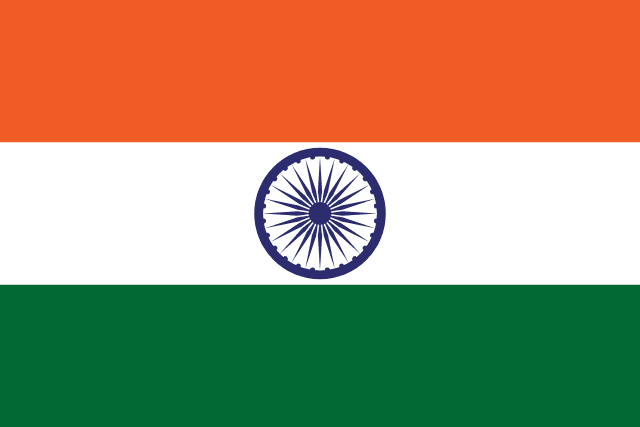
India — flagcdn.com/w640
Datos clave
- Adopción
- 22 July 1947 (adopted by the Constituent Assembly)
- Proporciones
- 2:3
- Diseño
- Pingali Venkayya, designer of the original tricolour scheme
- Capital
- · 05:18 (hora local ahora)
Qué significan los colores y símbolos
SaffronDocumentado / oficial
Stands for strength and courage, and for selflessness — Radhakrishnan's official gloss in the 1947 Constituent Assembly.
White and the Ashoka ChakraDocumentado / oficial
White stands for truth and peace; the navy-blue 24-spoked Ashoka Chakra is the eternal wheel of dharma and of life in movement — again Radhakrishnan's gloss; its form comes from the Lion Capital of Ashoka at Sarnath.
GreenDocumentado / oficial
Stands for the relation to the soil and fertility. Radhakrishnan stated explicitly that the colours do NOT stand for religious communities — a point the official gloss took care to clarify against a common misreading.
Breve historia
Venkayya proposed the tricolour to Gandhi in 1921; the 1931 Karachi resolution fixed saffron-white-green with a spinning wheel. On Nehru's motion the Constituent Assembly replaced the wheel with the Ashoka Chakra on 22 July 1947, and the flag rose at independence. India's Flag Code regulates its display in detail.
Explora este país
Ciudades de este país
Imágenes de banderas: FlagCDN (flagcdn.com). Los significados, las fechas de adopción y las proporciones se compilan de registros vexilológicos públicos y fuentes oficiales; cada entrada de simbolismo se etiqueta como documentada/oficial o como lectura popular (no oficial). Lo que no pudo verificarse se omite, no se adivina.
De este sitio
🎉 Cuentas atrás en directo a los festivales del mundo
Fiesta de la Primavera, Navidad, Pascua, Diwali, el próximo cambio de horario y más, cada uno con su página y su tarjeta para compartir.
De este sitio
🧰 Herramientas de tiempo gratuitas en una sola caja
Hora exacta con milisegundos, conversor Unix, cronómetro, temporizador, calculadora de duración y de semana/edad.
Fuentes de datos: Open-Meteo (el tiempo) · ExchangeRate API (divisas, actualización por horas/días) · Nager.Date (festivos) · Wikipedia (tal día como hoy) · GeoNames (datos básicos de ciudades, CC BY 4.0)