Asia
Sri Lanka · Qué significan los colores y símbolos
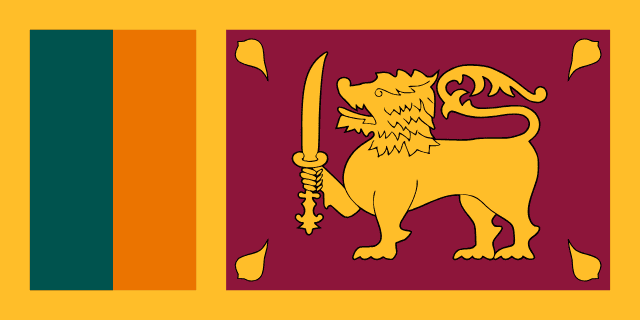
Sri Lanka — flagcdn.com/w640
Datos clave
- Adopción
- 14 February 1948 (first version); green and orange bands added 1951, the four bo leaves finalised 1972
- Proporciones
- 1:2
- Capital
- · 05:18 (hora local ahora)
Qué significan los colores y símbolos
Gold lion with swordDocumentado / oficial
Descends from the Sinhalese royal lion banner (the Vijaya legend and the Kandyan kingdom's flag) — the standard account; the lion stands for bravery and the majority community's heritage.
Green and orange bandsDocumentado / oficial
Added in 1951 on a parliamentary committee's recommendation: green for the Muslim community and orange for the Tamil community, so the flag embraces both major minorities — a matter of parliamentary record.
Maroon field and four bo leavesDocumentado / oficial
The maroon is the lion banner's field; the four bo-tree leaves (set in 1972, replacing pinnacle motifs) stand for loving-kindness, compassion, sympathetic joy and equanimity — the standard official gloss.
Breve historia
At independence in 1948 Ceylon took the Kandyan kings' gold lion as its flag; the green and orange bands joined in 1951 to include the minorities, and when the country became Sri Lanka in 1972 the corner motifs were set as bo leaves — the present design.
Explora este país
Ciudades de este país
Imágenes de banderas: FlagCDN (flagcdn.com). Los significados, las fechas de adopción y las proporciones se compilan de registros vexilológicos públicos y fuentes oficiales; cada entrada de simbolismo se etiqueta como documentada/oficial o como lectura popular (no oficial). Lo que no pudo verificarse se omite, no se adivina.
De este sitio
🎉 Cuentas atrás en directo a los festivales del mundo
Fiesta de la Primavera, Navidad, Pascua, Diwali, el próximo cambio de horario y más, cada uno con su página y su tarjeta para compartir.
De este sitio
🧰 Herramientas de tiempo gratuitas en una sola caja
Hora exacta con milisegundos, conversor Unix, cronómetro, temporizador, calculadora de duración y de semana/edad.
Fuentes de datos: Open-Meteo (el tiempo) · ExchangeRate API (divisas, actualización por horas/días) · Nager.Date (festivos) · Wikipedia (tal día como hoy) · GeoNames (datos básicos de ciudades, CC BY 4.0)