Oceania
Australia · What the colours & symbols mean
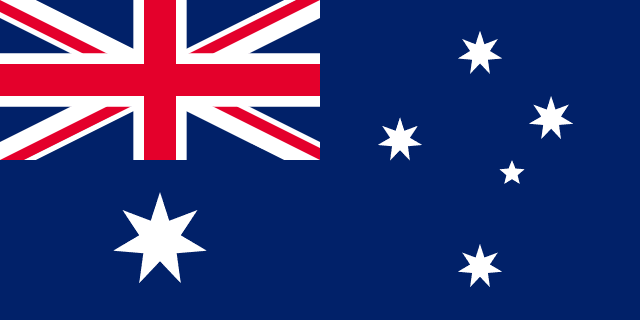
Australia — flagcdn.com/w640
Key facts
- Adopted
- 1901 (chosen by public competition); confirmed in law by the Flags Act 1953
- Proportions
- 1:2
- Designer
- Five co-winners of the 1901 public competition, including Annie Dorrington and Ivor Evans
- Capital
- · 10:44 (local time now)
What the colours & symbols mean
Union Jack cantonDocumented / official
Marks Australia's historical links with Britain and Commonwealth membership — the standard explanation under the Flags Act.
Seven-pointed Commonwealth StarDocumented / official
Six points for the six states and a seventh for the territories — officially documented.
Southern CrossDocumented / official
Represents Australia's position in the southern hemisphere; the five stars on the fly reproduce the Southern Cross constellation with its actual magnitudes and positions.
A brief history
After Federation in 1901 a public competition drew over 30,000 entries; five similar designs shared the prize and were merged. Britain approved the flag in 1903 and Australia legislated it in the Flags Act 1953. The blue ensign is the national flag (a red version serves as the merchant ensign).
Easily confused with
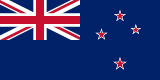
New Zealand's flag is also a blue ensign, but it has no Commonwealth Star and its Southern Cross has only four red stars with white borders; Australia has five white stars plus the large star below the canton.
Explore this country
Cities in this country
Flag images: FlagCDN (flagcdn.com). Meanings, adoption dates and proportions are compiled from public vexillological records and official sources; every symbolism entry is labelled as documented/official or as a popular (unofficial) reading. Where a fact could not be verified, it is omitted rather than guessed.
From this site
🎉 Live countdowns to the world's festivals
Spring Festival, Christmas, Easter, Diwali, the next daylight-saving change and more — each with its own page and a shareable countdown card.
From this site
🧰 Free time tools, all in one toolbox
Exact time with milliseconds, a Unix timestamp converter, stopwatch, countdown timer, duration and week & age calculators.
Data sources: Open-Meteo (weather) · ExchangeRate API (exchange rates, hourly/daily updates) · Nager.Date (holidays) · Wikipedia (On This Day) · GeoNames (data-layer city basics, CC BY 4.0)