Asia
Singapore · What the colours & symbols mean
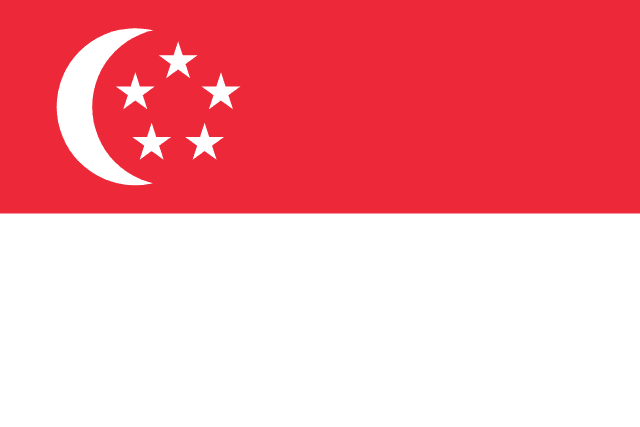
Singapore — flagcdn.com/w640
Key facts
- Adopted
- 3 December 1959
- Proportions
- 2:3
- Designer
- Designed by a committee led by Deputy Prime Minister Toh Chin Chye
- Capital
- · 07:44 (local time now)
What the colours & symbols mean
RedDocumented / official
Stands for universal brotherhood and equality of man — Singapore's official published explanation.
WhiteDocumented / official
Stands for pervading and everlasting purity and virtue.
CrescentDocumented / official
Represents a young nation on the ascendancy.
Five starsDocumented / official
Represent the nation's ideals of democracy, peace, progress, justice and equality.
A brief history
Designed under Toh Chin Chye when Singapore gained self-government in 1959 and unveiled on 3 December that year; on independence in 1965 it was retained unchanged. The red-and-white also echoes the region's red-and-white flag tradition.
Easily confused with

Both are red-and-white, but Singapore's has a white crescent and five stars in the canton; Indonesia's is plain bicolour.
Explore this country
Cities in this country
Flag images: FlagCDN (flagcdn.com). Meanings, adoption dates and proportions are compiled from public vexillological records and official sources; every symbolism entry is labelled as documented/official or as a popular (unofficial) reading. Where a fact could not be verified, it is omitted rather than guessed.
From this site
🎉 Live countdowns to the world's festivals
Spring Festival, Christmas, Easter, Diwali, the next daylight-saving change and more — each with its own page and a shareable countdown card.
From this site
🧰 Free time tools, all in one toolbox
Exact time with milliseconds, a Unix timestamp converter, stopwatch, countdown timer, duration and week & age calculators.
Data sources: Open-Meteo (weather) · ExchangeRate API (exchange rates, hourly/daily updates) · Nager.Date (holidays) · Wikipedia (On This Day) · GeoNames (data-layer city basics, CC BY 4.0)