Asien
Philippinen · Was Farben & Symbole bedeuten
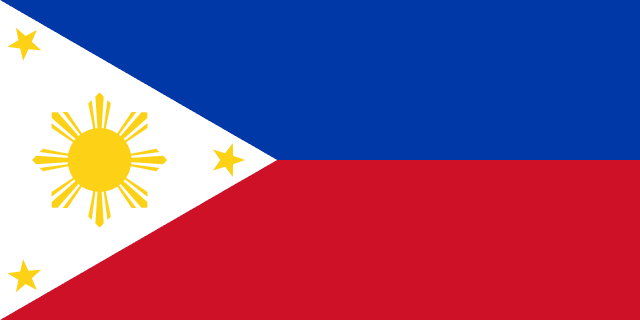
Philippinen — flagcdn.com/w640
Eckdaten
- Eingeführt
- 12 June 1898 (first raised at the independence proclamation); current specification under the 1998 Flag and Heraldic Code
- Proportionen
- 1:2
- Entwurf
- Designed by Emilio Aguinaldo; sewn by Marcela Agoncillo and companions
- Hauptstadt
- · 08:05 (Ortszeit jetzt)
Was Farben & Symbole bedeuten
White equilateral triangleBelegt / offiziell
Stands for liberty, equality and fraternity — stated in the 1898 Act of the Proclamation of Independence.
Sun and eight raysBelegt / offiziell
The sun symbolises liberty; its eight primary rays stand for the first eight provinces that rose in the revolution — likewise documented in 1898.
Three starsBelegt / offiziell
Represent the three island groups: Luzon, the Visayas and Mindanao.
Blue and redBelegt / offiziell
Per the 1898 text, blue stands for peace, truth and justice, red for patriotism and valour. Uniquely, in wartime the flag is flown with the red stripe on top.
Kurze Geschichte
Designed by Aguinaldo in exile in Hong Kong in 1897–98 and sewn there by Marcela Agoncillo, her daughter and niece, it was raised at the Kawit independence proclamation on 12 June 1898. Banned or altered under US and Japanese rule, restored at independence in 1946, the 1998 code fixed the blue as royal blue and set today's specification.
Dieses Land entdecken
Städte in diesem Land
Flaggenbilder: FlagCDN (flagcdn.com). Bedeutungen, Einführungsdaten und Proportionen sind aus öffentlichen vexillologischen Quellen und amtlichen Angaben zusammengestellt; jeder Deutungseintrag ist als belegt/offiziell oder als Volksdeutung (nicht offiziell) gekennzeichnet. Was sich nicht belegen ließ, wurde weggelassen statt geraten.
Von dieser Website
🎉 Live-Countdowns zu den Festen der Welt
Frühlingsfest, Weihnachten, Ostern, Diwali, die nächste Zeitumstellung und mehr — jedes mit eigener Seite und teilbarer Countdown-Karte.
Von dieser Website
🧰 Kostenlose Zeit-Werkzeuge in einer Werkzeugkiste
Exakte Zeit mit Millisekunden, Unix-Konverter, Stoppuhr, Countdown-Timer, Dauer- und Wochen-/Altersrechner.
Datenquellen: Open-Meteo (Wetter) · ExchangeRate API (Wechselkurse, stündliche/tägliche Aktualisierung) · Nager.Date (Feiertage) · Wikipedia (Historischer Tag) · GeoNames (Stadt-Basisdaten, CC BY 4.0)