Asia
Filipinas · Qué significan los colores y símbolos
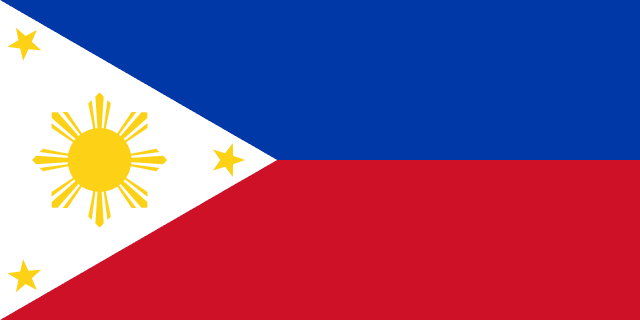
Filipinas — flagcdn.com/w640
Datos clave
- Adopción
- 12 June 1898 (first raised at the independence proclamation); current specification under the 1998 Flag and Heraldic Code
- Proporciones
- 1:2
- Diseño
- Designed by Emilio Aguinaldo; sewn by Marcela Agoncillo and companions
- Capital
- · 07:48 (hora local ahora)
Qué significan los colores y símbolos
White equilateral triangleDocumentado / oficial
Stands for liberty, equality and fraternity — stated in the 1898 Act of the Proclamation of Independence.
Sun and eight raysDocumentado / oficial
The sun symbolises liberty; its eight primary rays stand for the first eight provinces that rose in the revolution — likewise documented in 1898.
Three starsDocumentado / oficial
Represent the three island groups: Luzon, the Visayas and Mindanao.
Blue and redDocumentado / oficial
Per the 1898 text, blue stands for peace, truth and justice, red for patriotism and valour. Uniquely, in wartime the flag is flown with the red stripe on top.
Breve historia
Designed by Aguinaldo in exile in Hong Kong in 1897–98 and sewn there by Marcela Agoncillo, her daughter and niece, it was raised at the Kawit independence proclamation on 12 June 1898. Banned or altered under US and Japanese rule, restored at independence in 1946, the 1998 code fixed the blue as royal blue and set today's specification.
Explora este país
Ciudades de este país
Imágenes de banderas: FlagCDN (flagcdn.com). Los significados, las fechas de adopción y las proporciones se compilan de registros vexilológicos públicos y fuentes oficiales; cada entrada de simbolismo se etiqueta como documentada/oficial o como lectura popular (no oficial). Lo que no pudo verificarse se omite, no se adivina.
De este sitio
🎉 Cuentas atrás en directo a los festivales del mundo
Fiesta de la Primavera, Navidad, Pascua, Diwali, el próximo cambio de horario y más, cada uno con su página y su tarjeta para compartir.
De este sitio
🧰 Herramientas de tiempo gratuitas en una sola caja
Hora exacta con milisegundos, conversor Unix, cronómetro, temporizador, calculadora de duración y de semana/edad.
Fuentes de datos: Open-Meteo (el tiempo) · ExchangeRate API (divisas, actualización por horas/días) · Nager.Date (festivos) · Wikipedia (tal día como hoy) · GeoNames (datos básicos de ciudades, CC BY 4.0)