Asia
Turkmenistán · Qué significan los colores y símbolos
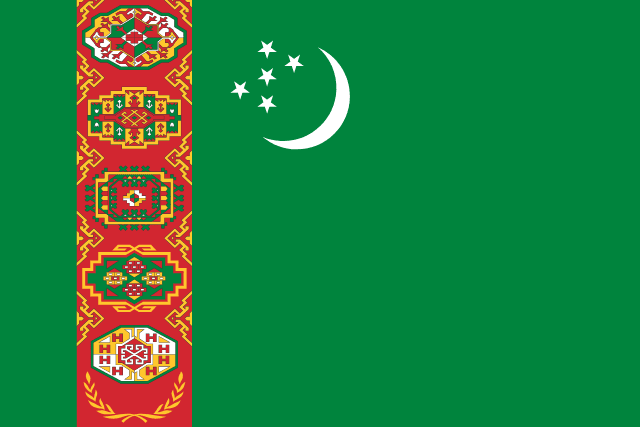
Turkmenistán — flagcdn.com/w640
Datos clave
- Adopción
- 27 January 1997 (current adjusted version)
- Proporciones
- 2:3
- Capital
- · 04:48 (hora local ahora)
Qué significan los colores y símbolos
SymbolismDocumentado / oficial
No official explanation has been given for the flag's colours or the white devices.
Five carpet guls on the red bandLectura popular, no oficial
A documented design fact: the five carpet motifs stand, top to bottom, for the five major Turkmen tribes — Teke, Yomut, Saryk, Chowdur and Ersari; carpet guls are also an emblem of Turkmenistan's famed carpet industry.
Crossed olive branches (base of the red band)Lectura popular, no oficial
Added by a 1997 amendment, marking the UN's declaration of 12 December 1995 that recognised Turkmenistan's permanent neutrality.
Five white stars and crescent (standard reading)Lectura popular, no oficial
The five white stars are commonly explained as Turkmenistan's five provinces (Ahal, Balkan, Daşoguz, Lebap, Mary); some flag guides also say 'the crescent and stars represent the Five Pillars of Islam' — that claim coexists with the record that no official explanation exists, and is labelled here as a standard reading only. Green is commonly read as life, land, prosperity and peace, the crescent as the clear sky above the people.
Explora este país
Ciudades de este país
Imágenes de banderas: FlagCDN (flagcdn.com). Los significados, las fechas de adopción y las proporciones se compilan de registros vexilológicos públicos y fuentes oficiales; cada entrada de simbolismo se etiqueta como documentada/oficial o como lectura popular (no oficial). Lo que no pudo verificarse se omite, no se adivina.
De este sitio
🎉 Cuentas atrás en directo a los festivales del mundo
Fiesta de la Primavera, Navidad, Pascua, Diwali, el próximo cambio de horario y más, cada uno con su página y su tarjeta para compartir.
De este sitio
🧰 Herramientas de tiempo gratuitas en una sola caja
Hora exacta con milisegundos, conversor Unix, cronómetro, temporizador, calculadora de duración y de semana/edad.
Fuentes de datos: Open-Meteo (el tiempo) · ExchangeRate API (divisas, actualización por horas/días) · Nager.Date (festivos) · Wikipedia (tal día como hoy) · GeoNames (datos básicos de ciudades, CC BY 4.0)