Châu Á
Turkmenistan · What the colours & symbols mean
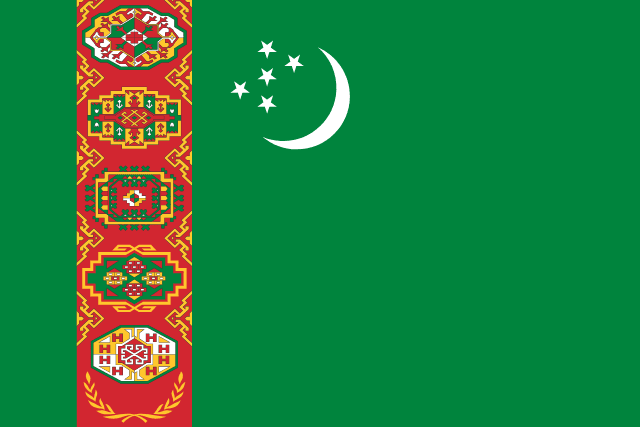
Turkmenistan — flagcdn.com/w640
Key facts
- Adopted
- 27 January 1997 (current adjusted version)
- Proportions
- 2:3
- Capital
- · 05:20 (local time now)
What the colours & symbols mean
SymbolismDocumented / official
No official explanation has been given for the flag's colours or the white devices.
Five carpet guls on the red bandPopular reading — not official
A documented design fact: the five carpet motifs stand, top to bottom, for the five major Turkmen tribes — Teke, Yomut, Saryk, Chowdur and Ersari; carpet guls are also an emblem of Turkmenistan's famed carpet industry.
Crossed olive branches (base of the red band)Popular reading — not official
Added by a 1997 amendment, marking the UN's declaration of 12 December 1995 that recognised Turkmenistan's permanent neutrality.
Five white stars and crescent (standard reading)Popular reading — not official
The five white stars are commonly explained as Turkmenistan's five provinces (Ahal, Balkan, Daşoguz, Lebap, Mary); some flag guides also say 'the crescent and stars represent the Five Pillars of Islam' — that claim coexists with the record that no official explanation exists, and is labelled here as a standard reading only. Green is commonly read as life, land, prosperity and peace, the crescent as the clear sky above the people.
Explore this country
Cities in this country
Flag images: FlagCDN (flagcdn.com). Meanings, adoption dates and proportions are compiled from public vexillological records and official sources; every symbolism entry is labelled as documented/official or as a popular (unofficial) reading. Where a fact could not be verified, it is omitted rather than guessed.
Từ trang này
🎉 Đếm ngược trực tiếp đến các lễ hội trên thế giới
Tết Nguyên Đán, Giáng sinh, Phục sinh, Diwali, lần đổi giờ tiếp theo và hơn nữa — mỗi sự kiện có trang riêng và thẻ đếm ngược để chia sẻ.
Từ trang này
🧰 Công cụ thời gian miễn phí, tất cả trong một hộp công cụ
Giờ chính xác đến mili giây, bộ chuyển đổi dấu thời gian Unix, đồng hồ bấm giờ, hẹn giờ đếm ngược, máy tính thời lượng và tuần/tuổi.
Nguồn dữ liệu: Open-Meteo (thời tiết) · ExchangeRate API (tỷ giá, cập nhật theo giờ/ngày) · Nager.Date (ngày lễ) · Wikipedia (Ngày này năm xưa) · GeoNames (dữ liệu cơ bản của thành phố, CC BY 4.0)