เอเชีย
เกาหลีใต้ · What the colours & symbols mean
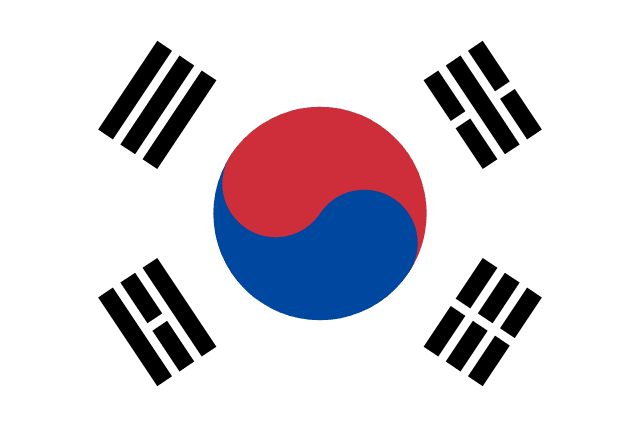
เกาหลีใต้ — flagcdn.com/w640
Key facts
- Adopted
- 1883 (first adoption; the current specification was standardised in stages after 1949)
- Proportions
- 2:3
- Capital
- · 09:23 (local time now)
What the colours & symbols mean
TaegeukDocumented / official
The red-and-blue taegeuk symbolises the harmony of yin and yang and cosmic balance — per the Korean government's published explanation of the flag.
Four trigramsDocumented / official
The trigrams in the corners — geon, gon, gam and ri — stand for heaven, earth, water and fire.
White fieldDocumented / official
Symbolises peace and purity, and the Korean people's traditional affinity for white.
A brief history
The Taegeukgi was created by envoy Bak Yeong-hyo's party in 1882–83 and adopted in 1883 — one of East Asia's earliest modern national flags. It became the emblem of the independence movement under Japanese rule and was retained by the Republic of Korea in 1948; its proportions and the taegeuk's geometry were fixed by successive national standards.
Explore this country
Cities in this country
Flag images: FlagCDN (flagcdn.com). Meanings, adoption dates and proportions are compiled from public vexillological records and official sources; every symbolism entry is labelled as documented/official or as a popular (unofficial) reading. Where a fact could not be verified, it is omitted rather than guessed.
จากเว็บไซต์นี้
🎉 นับถอยหลังสดสู่งานเทศกาลทั่วโลก
เทศกาลตรุษจีน คริสต์มาส อีสเตอร์ ดิวาลี การเปลี่ยนเวลาครั้งถัดไป และอีกมากมาย — แต่ละรายการมีหน้าเฉพาะและการ์ดนับถอยหลังที่แชร์ได้
จากเว็บไซต์นี้
🧰 เครื่องมือเวลาฟรี ทั้งหมดในกล่องเครื่องมือเดียว
เวลาที่แม่นยำระดับมิลลิวินาที ตัวแปลงเวลา Unix นาฬิกาจับเวลา ตัวจับเวลานับถอยหลัง เครื่องคำนวณระยะเวลาและสัปดาห์/อายุ
แหล่งข้อมูล: Open-Meteo (สภาพอากาศ) · ExchangeRate API (อัตราแลกเปลี่ยน อัปเดตรายชั่วโมง/รายวัน) · Nager.Date (วันหยุด) · วิกิพีเดีย (วันนี้ในอดีต) · GeoNames (ข้อมูลพื้นฐานของเมือง CC BY 4.0)