Asya
Güney Kore · What the colours & symbols mean
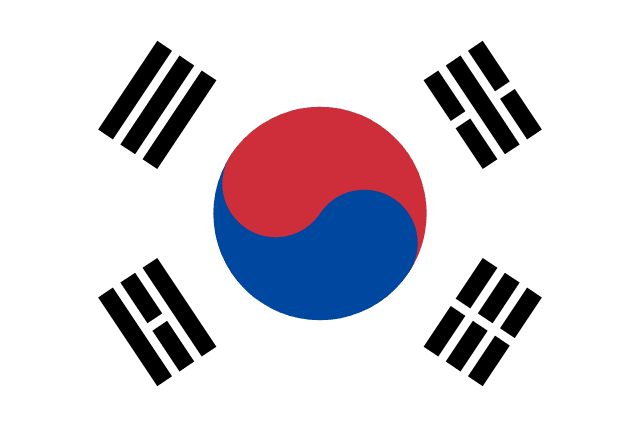
Güney Kore — flagcdn.com/w640
Key facts
- Adopted
- 1883 (first adoption; the current specification was standardised in stages after 1949)
- Proportions
- 2:3
- Capital
- · 09:17 (local time now)
What the colours & symbols mean
TaegeukDocumented / official
The red-and-blue taegeuk symbolises the harmony of yin and yang and cosmic balance — per the Korean government's published explanation of the flag.
Four trigramsDocumented / official
The trigrams in the corners — geon, gon, gam and ri — stand for heaven, earth, water and fire.
White fieldDocumented / official
Symbolises peace and purity, and the Korean people's traditional affinity for white.
A brief history
The Taegeukgi was created by envoy Bak Yeong-hyo's party in 1882–83 and adopted in 1883 — one of East Asia's earliest modern national flags. It became the emblem of the independence movement under Japanese rule and was retained by the Republic of Korea in 1948; its proportions and the taegeuk's geometry were fixed by successive national standards.
Explore this country
Cities in this country
Flag images: FlagCDN (flagcdn.com). Meanings, adoption dates and proportions are compiled from public vexillological records and official sources; every symbolism entry is labelled as documented/official or as a popular (unofficial) reading. Where a fact could not be verified, it is omitted rather than guessed.
Bu siteden
🎉 Dünya festivallerine canlı geri sayım
Bahar Bayramı, Noel, Paskalya, Diwali, bir sonraki saat değişikliği ve daha fazlası — her birinin kendi sayfası ve paylaşılabilir geri sayım kartı var.
Bu siteden
🧰 Ücretsiz zaman araçları, hepsi bir araç kutusunda
Milisaniyeli kesin saat, Unix zaman damgası dönüştürücü, kronometre, geri sayım sayacı, süre ve hafta/yaş hesaplayıcıları.
Veri kaynakları: Open-Meteo (hava durumu) · ExchangeRate API (döviz kurları, saatlik/günlük güncelleme) · Nager.Date (tatiller) · Vikipedi (Tarihte bugün) · GeoNames (şehir temel verileri, CC BY 4.0)